


Introduction
One of the pleasures of spending so much time discussing interesting legal questions about AI is that the conversation quite often drifts into something deeper. What really is intelligence? What does it mean to be conscious and how can we know what’s real and what isn’t?
My daughter asked me recently whether I think we are living in a simulation. I said I wasn’t convinced.
Then I found myself at a legal tech event, hearing about AI’s power to turn large amounts of complicated information into simple, digestible points, while receiving messages from readers about a case involving a 300-page ChatGPT-assisted skeleton argument.
Before I knew it, a robot carrying free chocolate was escorting me towards the latest legal AI technology. I subsequently collected a caricature of myself in a toga, drawn by Steve the Caricature & Silhouette Portrait Artist and a complimentary pair of socks.
When I got home, I told my daughter that I might need to reconsider my answer….
In this legal article, I am going to briefly summarise some of the most important developments and discussions in AI law from the past week. There are several issues that I will need to revisit in more detail in future articles, but I think it is important to share as much as possible now so that we can start thinking about what these developments mean for the legal profession and how we may need to respond.
“…They are racing straight to self-improving superintelligence and gambling with our lives…”
Jacob Coxon, who had recently resigned from Anthropic, the company behind the AI model Claude, received considerable media attention earlier this month for a series of posts warning about the potential dangers of advanced AI. Claude has featured in several of my previous legal articles.
Coxon’s posts on X can be read here, and I would suggest taking a few minutes to read the thread in full to understand the context of his concerns. In one post, Jacob stated:
“Do not underestimate the power of this technology. These will soon be superhuman systems that can hack anything, revolutionize any field overnight, and acquire real power and resources. We have all witnessed the progress in each of these domains, and progress is not slowing.”
Of course those are Coxon’s own predictions not established facts, but, after reading it, I thought it was important to share on LinkedIn with the simple observation:
“We need to start taking this very seriously.”
Despite all the posts I have written about significant developments in AI law, that short message appears to have received more impressions than anything else I have published on LinkedIn. I am still not entirely sure why, but perhaps it reflects how strongly these wider questions resonate.
Taking a warning seriously does not require accepting every prediction it contains. Nor do I think we gain much by speculating about someone’s motives rather than examining their arguments.
But if AI systems are, or become, able to improve themselves, or substantially accelerate the development of more capable systems, the implications could be profound. For lawyers, that raises practical questions about confidentiality, cybersecurity, verification, professional responsibility, evidence, equality of arms and the ability of courts and regulators to keep pace.
Future Disputes UK 2026: hallucinations and the future of lawyers
I really enjoy these events. If you have not attended a legal tech event before, I would encourage you to give one a try. They bring together a remarkable number of bright and thoughtful people grappling with the AI issues I often write about and trying to develop practical solutions to them.
As much as I enjoy discussions on social media and by email, there is nothing quite like speaking to people directly and getting into the weeds of these issues. I learn as much from listening to others as I hope they gain from hearing my views.
There were far too many interesting conversations and ideas to cover them all here, but I wanted to highlight just two points which stood out.
Firstly, AI hallucinations remain a problem in legal work. The issue has not been solved. Checking that a citation exists is not the same as checking that the legal analysis is right. As I have written previously, some of the more difficult hallucinations involve real cases and correct citations, but inaccurate accounts of the facts, reasoning or legal principles.
I welcome tools that help identify false authorities. But a citation checker is not, by itself, an answer to the wider problem. I am not convinced that meaningful human oversight can safely be removed from legal work simply because fabricated citations become easier to detect.
Secondly, I have been quite disheartened by the fears I hear from younger lawyers about what AI may mean for their future careers. I am also concerned by some of the messaging around this. I regularly hear podcasts and talks in which someone confidently asserts that AI will replace paralegals, lawyers and eventually judges. I’m afraid I do not agree and don’t shy away from saying so. In fact, it was this constant stream of predictions that encouraged me to start tracking them. If you have not yet seen my Will AI Replace Lawyers? and Will AI Replace Judges? trackers, you may find them useful. Several readers have commented, so please send me any thoughts.
Some comments are more detailed or emphatic than others, but I find it interesting to see where the balance lies. My earlier 99-statement snapshot on the Will AI Replace Lawyers? Tracker classified, overall, 52% as “No or Unlikely”, 40% as “Yes to some extent”, 3% as “Yes” and 5% as “Mixed or Uncertain”. These are approximate classifications of collected statements, not a representative survey or a forecast, but they do illustrate how mixed the views are.
I am still updating the tracker, so these figures are only preliminary. At present, however, the contrast between the groups is interesting. Among technology and investment voices, around 39% are classified as “No or Unlikely” and 52% as “Yes to some extent”. Among lawyers and judges collectively, the position is almost the reverse: around 60% are “No or Unlikely” and 33% “Yes to some extent”.
It raises an interesting question about why the two groups currently appear to see the issue so differently.
For my part, I am not going to pretend that AI will have little impact on legal work. I cannot think of anything in my lifetime with greater potential to transform the profession. But replacing tasks, reducing demand for particular roles and replacing the profession altogether are different propositions.
Law is not simply about finding information or producing words. Human connection, trust, judgment, persuasion and responsibility matter enormously. So too do understanding people and their motivations, reading a room, and knowing when to push and when to compromise.
My view is that the profession will evolve rather than disappear. That does not mean every existing job or training route will remain unchanged. But I would hate to see talented young people discouraged from such a rewarding career by messaging that treats its disappearance as inevitable. I feel I may need to revisit this topic more often.
Hancox v Sutherland & Ors
Turning now to some important cases. Firstly, we need to look at Hancox v Sutherland & Ors [2026] EAT 139.
On my reading, this does not appear to involve suspected or confirmed AI hallucinations, so it does not make the UK AI Hallucination Cases Tracker. However, the Tribunal discusses R (Ayinde) v London Borough of Haringey [2025] EWHC 1383 and several other cases that do appear on the tracker, so it is well worth reading in full.
In brief, a former National Farmers’ Union employee brought claims including whistleblowing detriment, unfair dismissal and disability discrimination. Those allegations were denied. This appeal concerned a claim against four individual respondents which the Employment Tribunal struck out in 2021, finding that a fair trial was no longer possible. While the full facts are available at the link above, my focus here is on the AI issues
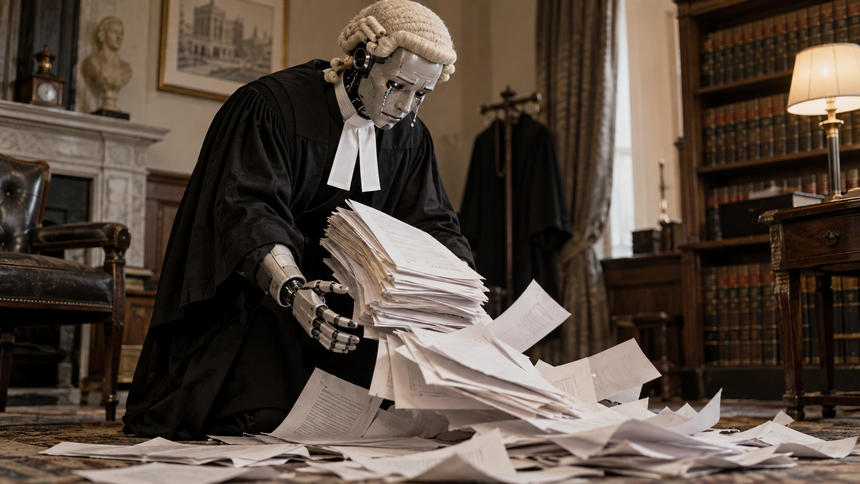
Two days before the preliminary hearing, the appellant filed his ChatGPT-assisted skeleton. His covering email asked the respondents to identify inaccuracies by 4 pm the following day.
The Practice Direction says skeleton arguments should generally be between 5-15 pages. Where a skeleton exceeds 20 pages, the judge may require a shorter version or reduce the time for oral submissions. This skeleton, however, ran to 300 pages and almost 132,000 words and failed to comply with other requirements.
Marcus Pilgerstorfer KC, sitting as a Deputy Judge of the High Court, recognised AI’s potential benefits, including for people without access to professional legal assistance. But its use does not remove responsibility for the resulting document. At paragraphs 31-33 he said:
“31. The potential risks posed by the use of generative AI are now widely known. There is no principled reason why a litigant in person should not take reasonable steps to use it responsibly. Whilst such a litigant will not usually be subject to the professional duties with which the court in Ayinde was primarily concerned, the underlying principles of personal responsibility and accuracy apply to all persons who submit documents to a court or tribunal.
32. In accordance with the guidance and authority I have cited above, litigants who use AI should ensure, at a minimum, that all documents submitted:
a) comply with applicable procedural rules – for example, in the EAT, PD§3.8 (grounds of appeal), and PD§11.6 (skeleton arguments);
b) have been checked as thoroughly as the litigant or representative is reasonably able for accuracy, ensuring that factual, evidential and legal points (including references to authorities) are correct and that the court or tribunal is not misled; and
c) contain only relevant points, with the focus being on the central or best arguments, presented in an easily comprehensible manner and avoiding undue repetition.
33. Simply submitting the product of generative AI to a court or tribunal, or placing the onus to check a document onto an opponent, is not acceptable. Where concerns arise that necessary checks have not been undertaken, or that they have been conducted inadequately, judicial enquiries and potential sanctions are likely to ensue.”
Applying these principles, the Judge explained at paragraph 84-85:
“84. The document filed was entirely unacceptable. It did not come close to complying with the requirements of the PD (see paragraph 18). It was not concise and was far in excess of the recommended length of 5 to 15 pages (and a 20 page upper limit). It was formed of numerous sections each with its own paragraph numbering. A uniform 12 point font size was not used. The argument referred to documents beyond the core bundle, no supplementary bundle having been prepared. In short, the document did not assist the EAT in preparing for the hearing; indeed, as the Appellant himself recognised in his covering email, there was simply insufficient time to consider it in full before the hearing.
85. At the preliminary hearing, I gave the Appellant the opportunity to address me on why a non-compliant skeleton had been lodged. The Appellant explained that he had used ChatGPT to create the document, and had done so because he had to prepare it quickly. He told me that much of the document lacked credibility and ultimately no reliance was placed on it. As I have explained, having chosen to use ChatGPT to assist him to prepare his skeleton argument, it was incumbent on the Appellant to check that the document submitted complied with the PD’s requirements. Further, he ought to have checked the contents of the skeleton to ensure that it was accurate and properly stated the position. I am satisfied that the Appellant did not undertake these checks. This is clear from the covering email and from the Appellant’s own assessment of the skeleton at the hearing.”
I should tread carefully here. Readers and colleagues have occasionally suggested that brevity is not my strongest suit, and I am putting that rather kindly.
But there is a serious question beneath the extraordinary length of this document: what does meaningful verification look like for someone without legal training?
The judgment does not ignore that difficulty. Its requirement is that accuracy checks be undertaken as thoroughly as the litigant or representative is reasonably able. It also refers to judicial guidance recognising that unrepresented litigants may have limited ability to verify AI-generated legal information.
Checking that a case exists is one thing. Assessing whether a proposition accurately reflects its reasoning, authority and application may be quite another. That difficulty cannot transfer responsibility to an opponent, but it should inform what practical guidance and assistance we provide.
For me, the important question is therefore not only whether litigants should take responsibility. It is how courts and the profession can help them discharge it. A warning to “check everything” may be necessary, but someone who turned to AI because they did not understand the law may also need help understanding how to check it.
Before leaving this case, I should also mentioned the Judge’s observations at paragraph 36 regarding evidence because it ties into the issues I discuss under the next heading.
“In addition, and depending on the circumstances, the use of AI may also cause a court or tribunal to be circumspect about the reliance that can properly be placed on a document or evidence. Responses to the Civil Justice Council’s Working Group on AI have raised concerns “about the potential for AI tools to reshape, embellish or otherwise influence evidence in ways that may not be immediately apparent”[13]. The use of ChatGPT in preparing witness statements resulted in a cautious approach to the evidence in Godwin v Godwin [2026] EWHC 923 (Ch) see §§42-49[14]. Witness coaching by AI, just as by other means, is not permitted: see R v FGD [2026] EWCA Crim 918 at §22. On the other side of the coin, suggesting that false factual information was purely the invention of an AI tool is also likely to require careful scrutiny: see for example Lodhia v Twelve Trees (Bromley-By-Bow) Management Company Limited [2026] EWHC 1889 (KB) at §§111, 119-120.”
A Police Officer asked AI to generate Victim Personal Statement to “make a judge or reader weep”
I try not to analyse court proceedings without seeing the judgment or transcript. I have not yet located the official text of this decision, so the following is a provisional account based on court reporting.
According to reports of Jerome Gibson’s sentence appeal, heard on 22 September 2026, the Court of Appeal was told that a police officer had used Microsoft Copilot to draft a victim personal statement.
The reported prompts sought a statement meeting a “higher harm category”, aimed at the “highest sentence” and intended to “make a judge or reader weep”.
Mr Justice Lavender reportedly described this use of AI as “deplorable”. However, the court said the facts relied upon in sentencing came from the victim’s interview. It did not appear that the AI use had increased the sentence and the appeal was dismissed.
Of course, that is not the same as a finding that every part of the statement was independently verified or that the drafting method was acceptable.
I need to see the full judgment before taking the analysis any further. But the reported circumstances raise a serious concern. Helping someone express their experience clearly is not the same as directing a tool to maximise punishment. My concern is where that line blurs: when assistance in recording an account becomes outcome-driven embellishment. Readers who want to explore that concern in more detail, may wish to consider my more detailed analysis in these articles.
- R v FGD [2026] EWCA Crim 918: 10 Lessons on AI Witness Coaching.
- The Dangers of Using AI to Assist with Witness Statements: Lessons from Godwin v Godwin,
- A Further UK Hallucination Incident? Reflections on AI Witness Statements and ‘Own Words’ Requirements.
- AI Chatbot Legal Issues: Harms to Women and Girls, AI-Based Asylum Decisions and Smart Glasses in Court.
- Abraham v Hound Technology Ltd: 5 AI Legal Issues, “reflect rather than suggest a party’s case and evidence”.
Taken together, these cases seem to be pointing towards the same fundamental distinction. There is an important difference between using AI to help a person communicate what they genuinely remember or wish to say and using it to suggest, strengthen, or optimise, what their evidence should be. The reported circumstances of the Gibson appeal may provide another important example of where that boundary needs to be examined.
Should Artificial Intelligence be called “Super Intelligence”?
In his address to the United Nations on 22 September 2026, President Donald Trump is reported to have said:
“The United States totally rejects any attempt to construct a globalist scheme of control for the Artificial Intelligence being spoken of so much now — hereinafter officially called ‘Super Intelligence.’”
Rather selfishly, my first thought was rebranding. Do I now need to rename my legal articles “Natural and Super Law”? Do I practise in Artificial Intelligence Law or Super Intelligence Law?
More seriously, in law, language matters. I can easily imagine a client asking why a legal proposition produced by something called a “super intelligence” still needs checking or, increasingly, whether they should follow their lawyer’s advice or the advice of the super intelligence. That concern may ultimately prove overstated, but it is something we will need to watch closely.
/Passle/5b3f2cb9780ebf0410d034b3/SearchServiceImages/2026-09-25-13-00-15-482-6ab6705f5442e4bec6a24667.jpg)
/Passle/5b3f2cb9780ebf0410d034b3/MediaLibrary/Images/62cbdb4cf636e90f90cbb708/2023-12-01-17-45-47-680-656a1bcbc939f53538e0fca7.jpg)
/Passle/5b3f2cb9780ebf0410d034b3/MediaLibrary/Images/62cbdb4cf636e90f90cbb708/2023-11-16-15-35-05-870-655636a93d4d3db2aa2b7272.jpg)